Continuous monitoring of look-alike domains, credential and breach exposure and AI-reputation risk — outside-in exposure that never reaches internal telemetry, promoted into the same threat queue as every other detection.
The other five capabilities operate on telemetry sent into the platform. Digital Risk Protection monitors the attack surface outside organisational control — domains registered to impersonate the brand, credentials surfacing in breach data, and how the brand is represented in AI-generated answers. None of it appears in internal logs, so a SIEM alone cannot detect it.
Typosquat and homoglyph domains registered to impersonate the brand are flagged at registration, scored on mail capability, live hosting, valid TLS and registration age.
Credentials tied to monitored domains surfacing in breach and stealer-log data are reported as actionable threats, enabling forced resets before the credentials are used.
How the major AI models answer questions about the brand is monitored continuously, treating false, damaging or reputation-shaping claims as a security and governance risk.
High and medium findings are promoted to managed threats in the standard queue, auto-triaged, assigned to owners and governed like any other threat.
Corporate domains and brands, continuously
Mail capability, hosting, certificate, age
High and medium findings become threats
Triaged, assigned and closed in the queue
One row per brand or asset, showing look-alike domains detected, credential and AI-reputation exposure, open threats, and the estimated financial exposure that carries.
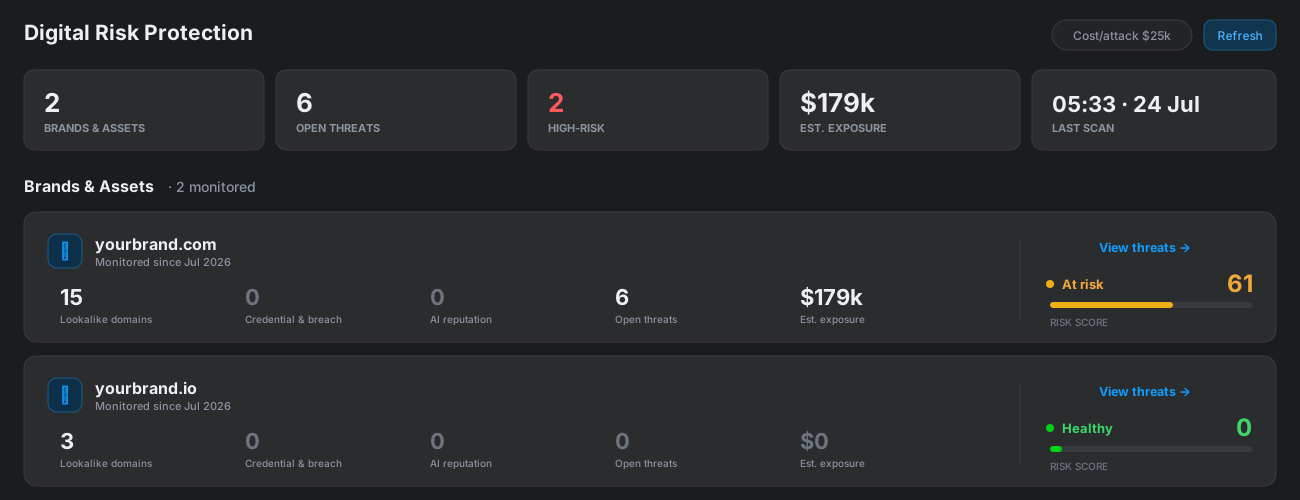
Impersonation and credential exposure that a SIEM cannot detect arrive in the existing threat queue, without operating a separate digital-risk console.
Look-alike domains and false AI claims are detected early, with the evidence required for takedown preparation, credential resets or a recorded benign determination.
External exposure reported as a measurable figure, tuned to the modelled cost of an attack on the organisation.
External risk does not sit in a separate system. It becomes a threat like any other, feeds the same triage and response, and evidences the controls that demonstrate monitoring beyond the perimeter.
External detections are written to the same context as internal telemetry, so findings sit alongside everything else collected.
High-risk findings are promoted to managed threats and triaged alongside internal detections, under one queue and one operating model.
Monitoring the external attack surface is itself a control, and the evidence of that monitoring is collected automatically.
AI-reputation monitoring runs on the same governed models used elsewhere, so brand risk in AI answers is both watched and audited.